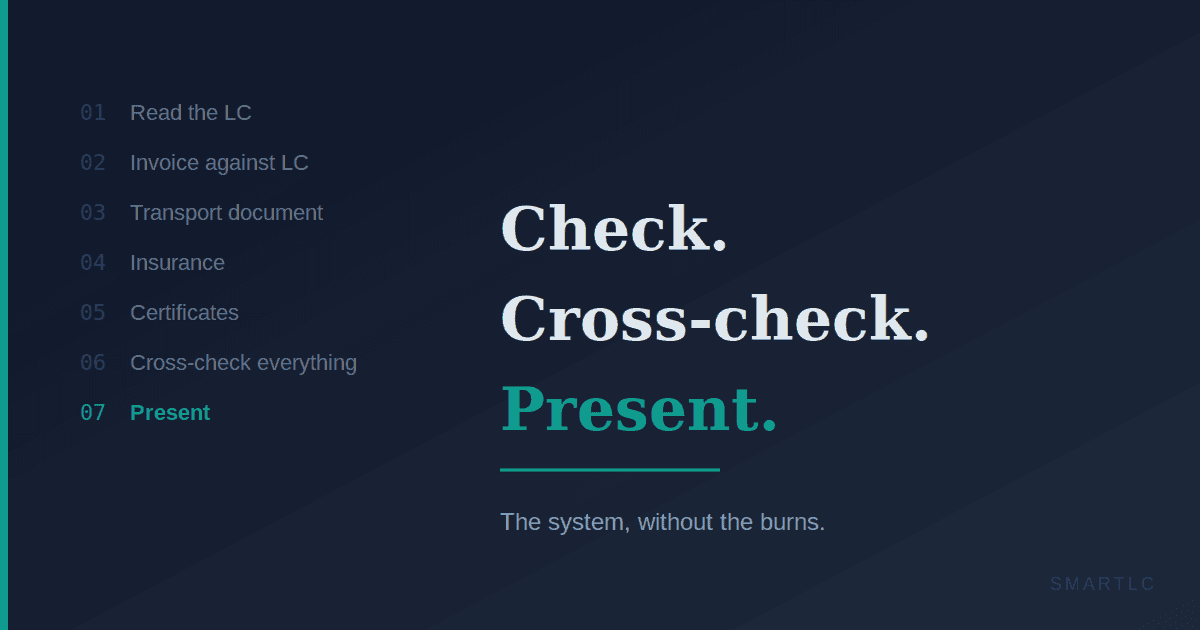
Every experienced document checker has a system. Most of them learned it by getting burned. Here's the system, without the burns.
This isn't a guide to what each document should contain — that depends on the LC. This is the order of operations: a repeatable process for checking a set of documents against an LC before you present them to the bank.
Step 1 — Start with the LC, not the documents
Before you touch a single document, re-read the LC. Not the version from memory. The current version, including every amendment you've accepted.
Make a list. What documents does Field 46A require? What additional conditions does Field 47A impose? What's the presentation deadline? What's the goods description in Field 45A — exact wording? What's the latest shipment date? What are the ports?
This list is your checklist for everything that follows. If you don't know exactly what the LC demands, you can't verify that the documents comply.
Step 2 — Commercial invoice against the LC
The invoice gets checked first because it's the strictest match. UCP 600 Article 18(c) requires the goods description on the invoice to correspond with the description in the LC. Not "be consistent with" — correspond.
Go word by word. Compare the goods description on the invoice against Field 45A of the LC. Every noun, every adjective, every quantity, every unit. If the LC says "1,200 cartons" and the invoice says "1,200 ctns," you have a problem.
Check the invoice amount against Field 32B. If there's a tolerance in Field 39A, verify the amount falls within it. Check that the invoice doesn't exceed the LC amount under any circumstances.
Confirm the invoice is made out to the applicant exactly as named in the LC. Confirm the invoice shows the LC number correctly.
Step 3 — Transport document against the LC
The bill of lading, airway bill, or other transport document. Check in this order:
Is it the type of transport document required by the LC? If the LC says "ocean bill of lading," an airway bill won't do.
Is it "shipped on board" or "received for shipment"? If received for shipment, is there a dated on-board notation?
Does the port of loading match Field 44A/44E? Does the port of discharge match Field 44B/44F?
Is the consignee correct? Does it match exactly what the LC specifies? If "to order," is it blank endorsed?
Is the notify party correct, if required?
Is the on-board date on or before the latest shipment date in Field 44C?
Is it clean — no clauses indicating defective goods or packaging?
Is the freight indication correct — prepaid or collect, as the LC requires?
Do you have the full set of originals required?
Step 4 — Insurance document against the LC
If the LC requires insurance, check the insurance certificate or policy.
Does it cover the risks specified in the LC? If the LC says "all risks," the document must include that phrase.
Is the amount correct — typically 110% of the CIF or CIP value, unless the LC specifies otherwise?
Is the currency the same as the LC?
Is the document dated no later than the shipment date, or does it show that coverage was effective from before shipment?
Is it issued by an insurance company or underwriter, not a broker?
Step 5 — Certificates and other required documents
Certificate of origin, packing list, weight certificate, inspection certificate, beneficiary certificate — whatever Field 46A and Field 47A require.
For each certificate, check three things:
Does it exist? It sounds obvious, but a missing document is the simplest discrepancy to make and the easiest to prevent. Go through the LC document list and tick off each one.
Does it contain the specific information required by the LC? If the LC says the certificate of origin must be issued by a specific chamber of commerce, or that the packing list must show container numbers, verify.
Is the description of goods consistent with the LC and the other documents? Certificates don't need to mirror the LC goods description exactly — but they must not contradict it.
Step 6 — Cross-document consistency
This is where many presentations fail even after each individual document looks correct. Put all the documents side by side and check for internal consistency.
Do the quantities match across the invoice, packing list, and BoL?
Do the weights agree — or at least not conflict — across all documents?
Is the goods description consistent everywhere? The invoice must match the LC exactly. Other documents can use a general description but must not contradict it.
Do the dates make sense? The insurance must be dated on or before shipment. The BoL date is the shipment date. The invoice date is usually on or before the BoL date. Certificates are usually dated around the same time.
Is the LC number shown correctly on every document that displays it?
Do all the party names and addresses match — not approximately, but exactly as they appear in the LC?
Step 7 — Conditions and special requirements
Go back to Field 47A. Read every condition. For each one, verify that the relevant document addresses it. Field 47A is free text, so the requirements can be oddly worded, contradictory, or ambiguous.
If a condition says "beneficiary must provide a signed statement that goods are not of Israeli origin," check that such a statement exists in the presentation, that it's signed, and that the wording matches. If a condition says "all documents must show LC number," verify that it appears on every document — not just the invoice.
The meta-rule
The most common checking mistake isn't getting a detail wrong. It's checking documents in isolation — verifying the invoice is correct, then verifying the BoL is correct, then verifying the packing list is correct — without ever comparing them to each other.
A presentation can contain five individually perfect documents that are collectively inconsistent. The weight on the packing list doesn't match the invoice. The port on the BoL doesn't match the certificate of origin. The shipment date on the BoL falls outside the period covered by the insurance.
Check each document against the LC. Then check every document against every other document. That second step is the one that separates clean presentations from discrepant ones.
David Berney is the founder of SmartLC, a trade finance platform for managing the Letter of Credit lifecycle. He builds software for the people who actually prepare, check, and present trade documents.