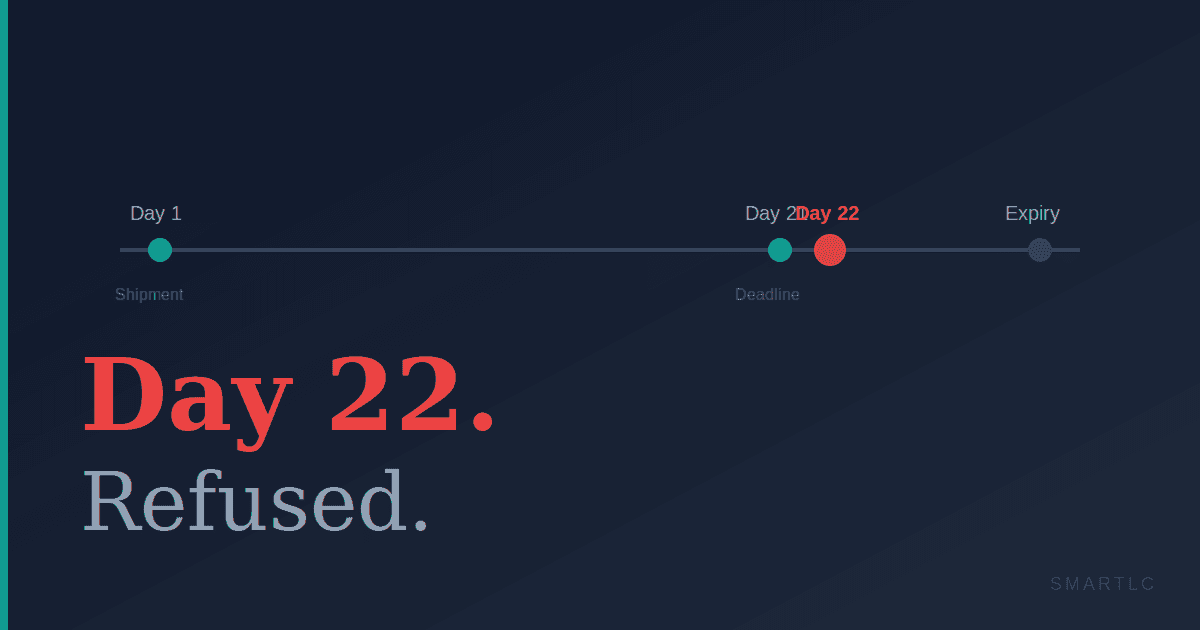
The 21-day clock starts ticking the moment goods are loaded onto the vessel. Not when your freight forwarder sends you the bill of lading. Not when you receive it. Not when you open the email. The moment the on-board date is stamped on the BoL.
That distinction has cost people real money.
The rule
UCP 600 Article 14(c) says documents must be presented within 21 calendar days after the date of shipment, but not later than the expiry date of the LC. If the LC specifies a shorter period in Field 48 — and many do — that shorter period applies.
Calendar days, not banking days. Weekends count. Public holidays count. The day after Christmas counts.
If your BoL is dated 3 March and your presentation period is 21 days, your deadline is 24 March. If the LC expires on 20 March, your deadline is 20 March. You always take the earlier date.
What the bank does
When documents arrive after the presentation deadline, the bank doesn't exercise judgement. There's no discretion to apply, no mitigating circumstances to consider. Late presentation is a discrepancy. The bank notes it in the refusal notice alongside whatever else they found.
This is sometimes the only discrepancy. Every document is perfect — the invoice matches, the BoL is clean, the certificates are in order — but the package arrived on day 22. Refused.
Your options after a late presentation
You have three, and none of them are good.
Request the applicant to waive the discrepancy. This is the most common route. The buyer instructs the issuing bank to accept the documents despite the late presentation. It works — but you're now dependent on the buyer's goodwill at the exact moment when you have the least leverage. The goods are already shipped. You need to be paid. The buyer knows this.
Some buyers waive discrepancies quickly and without fuss. Others use the moment to renegotiate pricing, request extended payment terms, or simply delay while they inspect the goods. A discrepancy that should take a day to resolve can stretch into weeks.
Re-present within the deadline. This only works if the late presentation wasn't caused by slow document preparation but by a logistical delay in getting the documents to the bank. If it's day 20 and you courier the documents today instead of posting them, you might still make it. But this is a fix for a narrow set of circumstances, and it doesn't help if the underlying problem is that you received the BoL too late.
Accept the refusal and negotiate directly with the buyer. This is effectively abandoning the LC as a payment mechanism and falling back to an open-account arrangement for this shipment. The LC was supposed to protect you from exactly this situation — having to trust the buyer to pay voluntarily. If you're here, the LC has failed at its one job.
The hidden cost
Discrepancy fees are the obvious cost. The issuing bank charges one, the advising bank may charge another, and if amendments or waivers are involved, those have fees too. For a single late presentation, the total cost might be a few hundred dollars. Annoying but survivable.
The real cost is the delay. An LC that should have settled in five banking days now takes three weeks while you wait for the waiver. If you were counting on that payment to fund the next production run, you've just created a cash flow gap. Multiply that across several shipments per month and the accumulated drag is significant.
There's also the reputational cost with your bank. Banks track discrepancy rates by client. A beneficiary who consistently presents clean documents gets faster processing and fewer queries. One who regularly presents late gets scrutinised more closely on everything else.
Why this keeps happening
The mechanics of the problem are straightforward. The BoL is issued by the shipping line or freight forwarder after the goods are loaded. That document then travels — physically or electronically — to the exporter. The exporter prepares the remaining documents, assembles the presentation, and submits everything to the bank.
Every step in that chain takes time, and the 21-day clock is running throughout. If the freight forwarder takes a week to release the BoL, you've already lost a third of your window. If your trade docs team is preparing documents for multiple shipments simultaneously, the remaining days can evaporate.
The companies that consistently present on time aren't working harder. They're tracking the deadline from the moment goods ship, following up on the BoL immediately, and preparing every other document in parallel so that the moment the BoL arrives, they can assemble and submit within days.
The companies that consistently present late are the ones who start the process when the BoL lands on their desk, then discover they have eight working days to do everything else.
The takeaway
Know your presentation deadline before you ship. Calculate it from the expected BoL date, not from when you think you'll receive the BoL. Build in buffer. And if you suspect you won't make it, request an amendment to extend the LC expiry or the shipment date before the deadline passes — not after.
A late presentation is the one discrepancy that's entirely within your control. It's also the one most likely to cost you your negotiating position.
David Berney is the founder of SmartLC, a trade finance platform for managing the Letter of Credit lifecycle. He builds software for the people who actually prepare, check, and present trade documents.