Nobody ever lost sleep over a packing list. Which is exactly why packing lists keep causing problems.
When exporters think about LC compliance, they worry about the bill of lading. They triple-check the commercial invoice. They chase the certificate of origin. The packing list? That gets filled in at the end, often by whoever happens to be near the keyboard, usually in a hurry.
And then the bank refuses the presentation because the packing list says 240 cartons and the invoice says 250.
The invisible document
The packing list occupies an odd position in an LC presentation. It's almost always required — Field 46A will list it alongside the invoice and BoL — but UCP 600 barely mentions it. There are no dedicated articles governing its content, unlike the commercial invoice (Article 18) or the bill of lading (Article 20). ISBP 745 offers some guidance, but the short version is: the packing list must not conflict with the LC or with any other document in the presentation.
That "must not conflict" standard is where the trouble starts.
Where packing lists go wrong
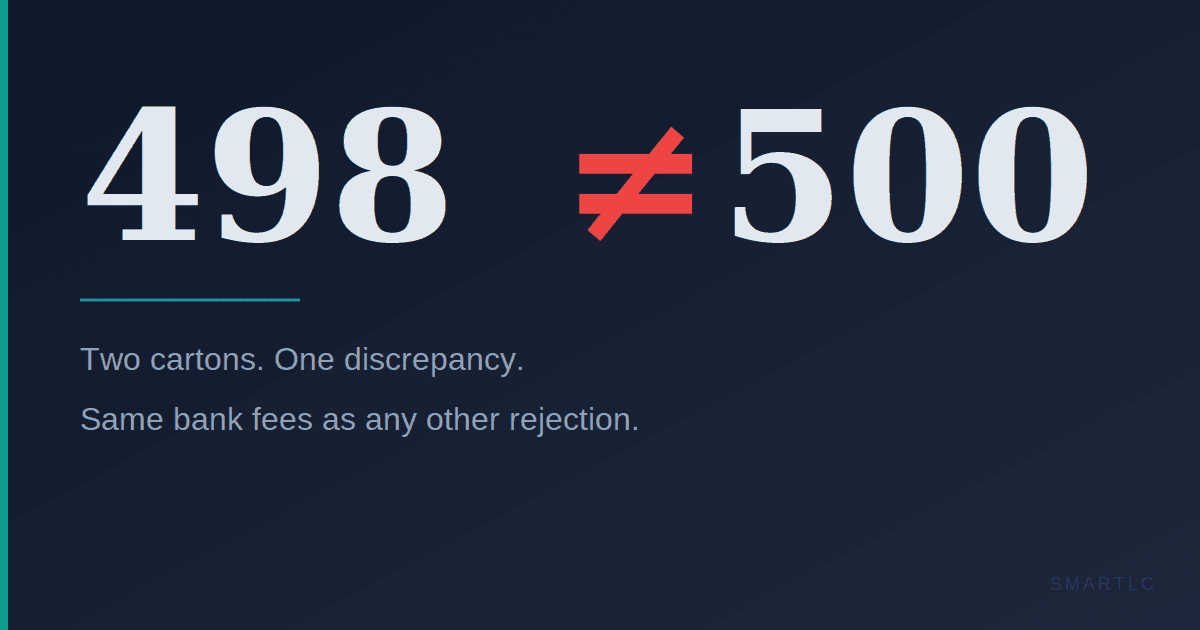
Quantity mismatches. The LC says 500 cartons. The invoice says 500 cartons. The packing list says 498 cartons, because two were damaged in the warehouse and pulled from the shipment at the last minute. Nobody updated the packing list. Nobody updated the invoice either, but the invoice was at least checked before submission. The packing list wasn't.
Weight discrepancies. The packing list breaks down the shipment by carton — individual gross and net weights. The invoice states a total weight. The BoL states another total weight. If these don't reconcile, or if the packing list totals don't match the individual line items, the bank has a discrepancy. Rounding differences are the usual culprit. One document rounds to one decimal place, another to two.
Description inconsistencies. The invoice must mirror the LC goods description exactly. The packing list doesn't have to — it can use a general description — but it can't contradict it. If the LC says "Grade A frozen chicken drumsticks" and the packing list says "frozen chicken parts," that's arguably inconsistent. Whether the bank flags it depends on the examiner, and that's not a gamble worth taking.
Missing information. Some LCs require the packing list to include specific details: shipping marks, container numbers, HS codes, lot numbers. These requirements are usually buried in Field 47A, the additional conditions field that most people read last and remember least. A packing list that's technically correct but missing a required field is still discrepant.
Why this keeps happening
The packing list is typically the last document prepared and the first one forgotten. It's treated as administrative — a box to tick, not a document to check. In many companies, it's prepared by the warehouse or logistics team, not the trade docs team. The people filling it in may never have read the LC.
There's also a timing problem. The packing list reflects the actual shipment — what was physically packed and loaded. But the LC was issued weeks or months earlier, based on a sales contract. If anything changed between contract and shipment — quantities adjusted, packaging switched, weights revised — the packing list will reflect reality while the invoice and BoL still reflect the LC terms. That gap between what was shipped and what the LC expected is where discrepancies breed.
The fix is boring
Check the packing list against the invoice and the BoL before you submit. Verify that quantities, weights, and descriptions are consistent across all three. Make sure any specific requirements from Field 46A or 47A are included.
That's it. No advanced technique, no clever workaround. Just the same discipline you apply to the invoice and the BoL, extended to one more document.
The packing list isn't glamorous. It's not complex. But a presentation that gets rejected over a ten-carton discrepancy costs you the same bank fees and the same payment delay as one rejected over a missing endorsement.
David Berney is the founder of SmartLC, a trade finance platform for managing the Letter of Credit lifecycle. He builds software for the people who actually prepare, check, and present trade documents.