Nobody budgets for the cost of a discrepancy. Nobody tracks the hours spent rebuilding an LC timeline from email threads. But those costs are real, and they compound.
Trade finance teams don't manage LCs badly. They manage them with tools that were never designed for the job. And the gap between what the tools can do and what the work requires is filled by human effort — effort that doesn't appear on any balance sheet but shows up in delayed payments, repeated errors, and the quiet dread of a missed deadline.
The time cost
A typical LC shipment involves reviewing the LC, preparing five to seven documents, cross-checking them against each other and against the LC terms, tracking the presentation deadline, managing correspondence with the buyer and freight forwarder, and coordinating with the bank.
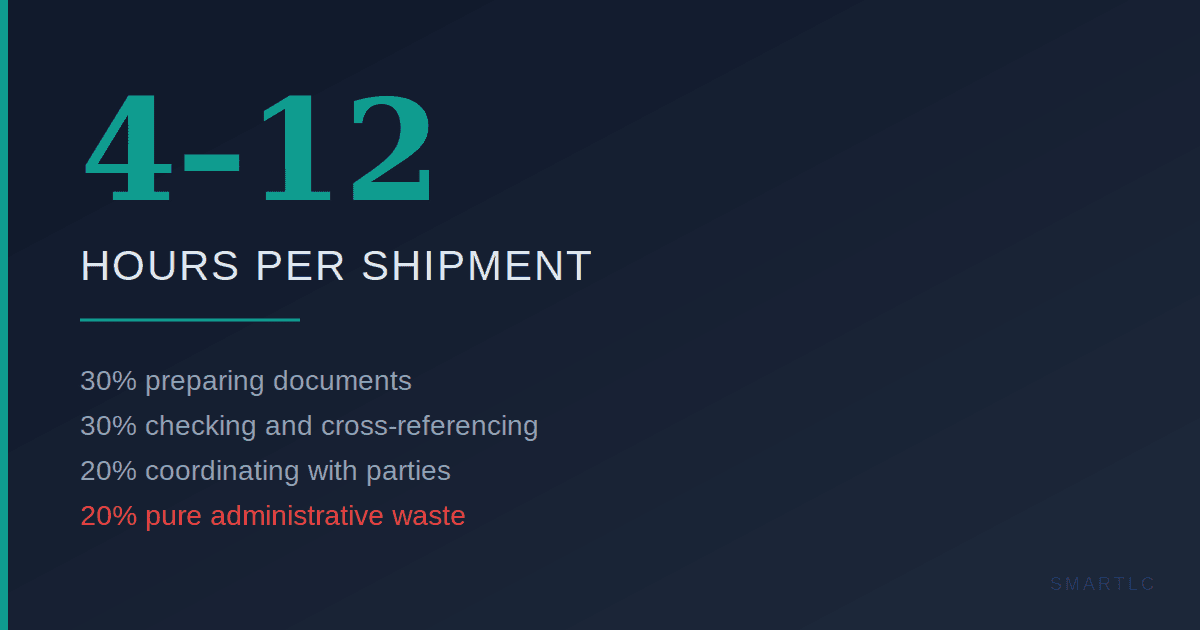
In a company managing this by email and spreadsheets, each shipment consumes somewhere between 4 and 12 hours of a trade documentation professional's time. The variance depends on the complexity of the LC, the number of amendments, and how much searching through old emails is required to find the current version of anything.
That time breaks down roughly like this: 30% preparing documents, 30% checking and cross-referencing, 20% coordinating with external parties, and 20% administrative overhead — locating the right LC version, updating the tracking spreadsheet, filing documents, chasing information that should already be at hand.
The administrative 20% is pure waste. It produces nothing. It exists only because there's no single source of truth for the LC, the documents, the deadlines, and the correspondence. Everything is scattered across inboxes, shared drives, and spreadsheets that one person maintains and everyone else tries to interpret.
For a company processing ten LC shipments per month, that administrative overhead represents roughly 8–24 hours of lost productive time. Per month. Every month. That's a quarter of someone's working time spent not on trade finance work, but on managing the absence of a system.
The error cost
Manual processes produce errors at a predictable rate. It's not a question of if but how often. The ICC's 60–75% first-presentation discrepancy rate is not caused by incompetent people. It's caused by a process that requires perfect accuracy across dozens of data points, with no automated verification, under time pressure.
Each discrepancy has a direct cost: bank fees on both sides, typically ranging from $50 to $250 per discrepancy depending on the bank and the jurisdiction. A company with a 50% discrepancy rate on ten shipments per month is paying $3,000–$15,000 per year in discrepancy fees alone.
The indirect costs are larger. A refused presentation delays payment by days or weeks — sometimes longer if the buyer is slow to grant a waiver. For a company operating on tight margins or funding the next production run from the proceeds of the current one, that delay has a financing cost. Working capital that's locked in transit earns nothing and costs whatever your facility charges.
Then there's the rework. A discrepant presentation means someone has to identify the problem, prepare corrected documents or request a waiver, coordinate with the bank and the buyer, and re-present if necessary. That's another 2–4 hours per incident — hours that could have been spent on the next shipment.
The knowledge cost
This is the one nobody talks about because it's invisible until someone leaves.
In most companies, LC management expertise is concentrated in one or two people. They know the process, they know the bank preferences, they know which freight forwarder is reliable and which one sends the BoL late. They carry a mental model of every active LC — deadlines, outstanding amendments, documents still needed.
When those people are unavailable — on leave, off sick, or gone to a competitor — the company discovers exactly how much of the operation was held together by individual knowledge rather than documented process. The replacement doesn't know that Bank X wants blue ink on the CoO. The replacement doesn't know that the buyer's LC always requires a specific certification that isn't obvious from Field 47A alone. The replacement doesn't know that "latest shipment 15th" means the BoL must be dated the 15th, not that the cargo must leave the warehouse by the 15th.
These knowledge gaps show up as discrepancies. They show up as missed deadlines. And they show up as stressed, capable people trying to do a job without the context they need.
What a system would change
The purpose-built alternative isn't more people or better spreadsheets. It's a system that holds the LC terms as structured data, cross-references documents against those terms automatically, tracks deadlines without human intervention, stores bank-specific preferences alongside the standard rules, and keeps all correspondence, documents, and amendments in one place.
That's not futuristic. That's what every other compliance-heavy workflow already has. Accounting has it. Legal has it. Procurement has it. Trade documentation — the process that determines whether you get paid for international shipments — does not.
The cost of building or buying such a system is measurable. The cost of not having one is equally measurable. Most companies just haven't done the maths.
The question worth asking
Add up the hours your team spends on LC administration per month. Add the discrepancy fees. Add the cost of delayed payments — even a rough estimate. Add the risk premium of having critical knowledge locked in one or two people's heads.
The total will be larger than you expect. It always is.
David Berney is the founder of SmartLC, a trade finance platform for managing the Letter of Credit lifecycle. He builds software for the people who actually prepare, check, and present trade documents.