Banks have spent billions digitising their side of trade finance. SWIFT messaging, automated compliance screening, electronic document examination workflows, API-driven KYC checks. The banking infrastructure behind a letter of credit in 2025 is genuinely sophisticated.
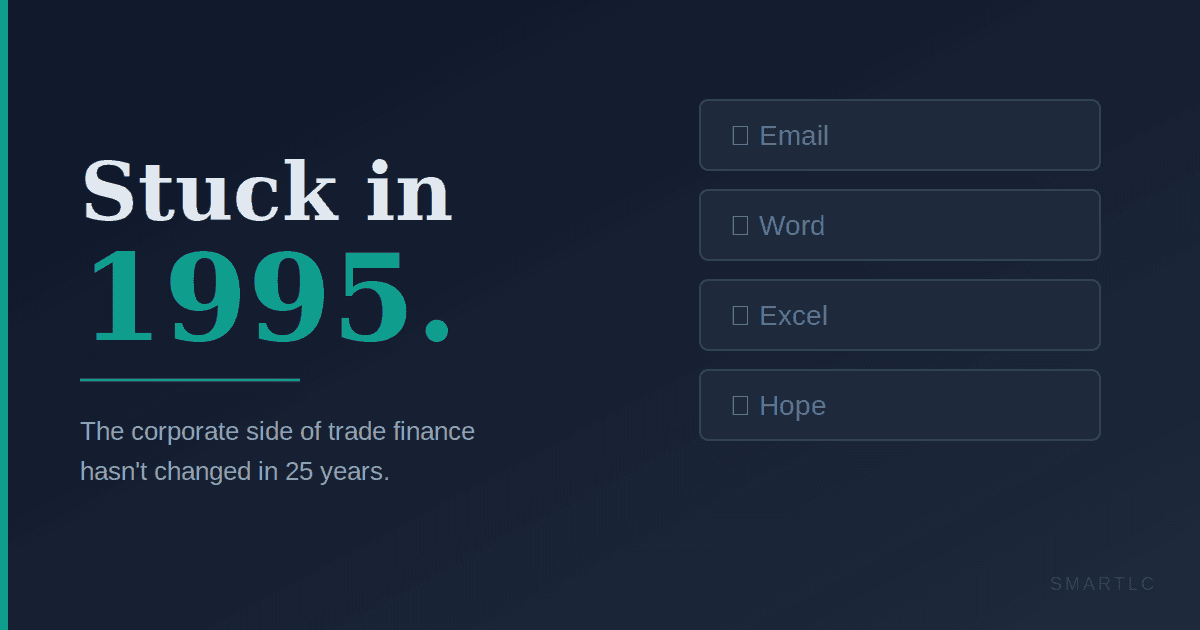
The exporter preparing documents on the other side of that transaction is copying and pasting from last month's Word template.
This isn't an exaggeration. I've spoken with companies that handle dozens of LC shipments per month — serious businesses, moving serious volumes — and their document preparation process is essentially: open the last invoice, change the numbers, hope the goods description still matches the current LC. The bill of lading comes in as a PDF attachment in an email. The compliance check is someone reading the LC and the documents side by side, sometimes on a printed page, and mentally ticking off each requirement.
It works, in the same way that anything works if you throw enough experienced people at it. But it fails at scale, it fails under time pressure, and it fails catastrophically when the experienced person leaves and nobody else knows which bank prefers the LC number in bold on the certificate of origin.
Where the money went
The trade finance technology investment over the past decade has overwhelmingly gone into three places: banking platforms, blockchain experiments, and supply chain visibility tools.
Banking platforms make sense. Banks handle millions of LCs and need industrial-grade systems for issuance, examination, and settlement. That's real infrastructure solving real problems.
Blockchain for trade finance has absorbed an extraordinary amount of capital and attention. Multiple consortia, multiple pilots, multiple white papers, and — so far — limited production adoption. The vision of a distributed ledger connecting all trade parties is appealing. The reality is that trade finance involves banks, corporates, shipping lines, insurers, and chambers of commerce across dozens of jurisdictions, and getting all of them onto a single platform is a coordination problem that technology alone can't solve.
Supply chain visibility is useful. Knowing where your container is matters. But knowing where your container is doesn't help you prepare a compliant document presentation. The goods can arrive perfectly while the documents fail.
What nobody built
The gap is in the middle. Between the bank's platform and the shipping line's tracking system, there's a person — usually in the exporter's trade documentation team — who has to take the LC terms, cross-reference them with the actual shipment details, prepare six or seven documents that are internally consistent and compliant with every LC condition, and present them within a deadline that's already half expired by the time the BoL arrives.
That person is using Microsoft Word, Outlook, and a spreadsheet. Maybe a shared drive if they're organised. Maybe a physical folder if they're not.
The tools available to them have not materially changed since the late 1990s. Email replaced fax. PDF replaced courier. But the core workflow — manually preparing documents, manually checking them against the LC, manually tracking deadlines — is identical to what it was twenty-five years ago.
This is, frankly, odd. There's purpose-built software for almost every other operational function in a trading company. Accounting has software. Logistics has software. CRM has software. HR has software. But the process that determines whether you actually get paid for the goods you shipped? That runs on email and hope.
Why it persists
Three reasons, as far as I can tell.
First, the people who do this work are very good at it. An experienced trade docs manager can prepare a clean presentation from memory, catch discrepancies by instinct, and manage deadlines in their head. The system works — until they go on holiday, or leave the company, or handle one too many shipments in a week and something slips.
Second, the market is niche. Trade finance sits at the intersection of banking, logistics, and international law. It's not a horizontal SaaS category with obvious product-market fit. The total number of companies that regularly use LCs is large in aggregate but spread across industries, countries, and company sizes. Building for this market requires deep domain knowledge, and most technology investors don't have it.
Third, inertia. The existing process is painful but familiar. Switching to a new system involves training, migration, and the risk that the new tool doesn't handle the edge cases that the spreadsheet handled just fine. For companies that have been doing this for twenty years, the devil they know is the one that's been getting them paid.
What "better" looks like
Better isn't blockchain. Better isn't a portal that just moves the same manual process online. Better is software that understands what an LC requires, checks documents against those requirements automatically, tracks deadlines without human intervention, and catches the "metric tons vs MT" discrepancy before the bank does.
It's not a radical concept. It's what accounting software does for invoices, what CRM software does for customer relationships, what project management software does for deadlines. It's purpose-built tooling for a specific operational workflow that currently has none.
The 60–75% first-presentation rejection rate isn't a failure of the people doing the work. It's a failure of the tools they're given. Give them software that's designed for this job, and that number drops. It has to. The errors are too systematic and too preventable to persist once you remove the manual process that creates them.
Trade finance is stuck in 1995. It doesn't have to be.
David Berney is the founder of SmartLC, a trade finance platform for managing the Letter of Credit lifecycle. He builds software for the people who actually prepare, check, and present trade documents.